6/10/16
SHORT-TERM FASTING MAY IMPROVE HEALTH
After years of fasting, the Buddha’s “legs were like bamboo sticks, his backbone was like a rope, his chest was like an incomplete roof of a house, his eyes sank right inside, like stones in a deep well,” according to one account. The Buddha didn’t get what he wanted from this extreme fasting—enlightenment—but a new study suggests that a diet that replicates some effects of milder deprivation may not only lower your weight but also confer other benefits. Researchers report that following the diet for just 5 days a month improves several measures of health, including reducing the risk of developing cardiovascular disease.
Eating shortens life, and not just because overindulgence can lead to diseases such as diabetes. A diet that cuts food intake by up to 40%, known as calorie restriction, increases longevity in a variety of organisms and forestalls cancer, heart disease, and other late-life illnesses. Although some short-term studies suggest that calorie restriction provides metabolic benefits to people, nobody has confirmed that it also increases human life span. The closest researchers have come are two large, long-term studies of monkeys, and they conflict about whether meager rations increase longevity.
Even if calorie restriction could add years to our lives, almost no one can muster the willpower to eat so little day after day, year after year. An alternative that might be more, er, palatable is fasting, the temporary abstinence from food. Gerontological researcher Valter Longo of the University of Southern California in Los Angeles and colleagues have shown that fasting eases side effects of chemotherapy such as fatigue and weakness, and animal studies suggest that it produces health advantages similar to calorie restriction.
But hard-core fasting, in which people drink only water for days at a time, may be no easier than calorie restriction. “I’ve done it, and it was excruciating,” Longo says. For the new study he and his colleagues devised a less grueling diet that might still trigger the benefits of fasting. For two 4-day periods each month, middle-aged mice dined on low-protein, low-calorie chow. The rest of the month, they could nosh as much as they wanted.
The mice outlived their peers by an average of 3 months, a substantial amount for the rodents, and they displayed numerous signs of better health. As the researchers report online today in Cell Metabolism, the mice shed fat and were 45% less likely to fall victim to cancer. During their lean cuisine episodes, their level of blood sugar fell by 40% and the amount of insulin in the blood was 90% lower. And although brainpower usually declines with age, the mice retained more of their mental ability; they bested control animals in two kinds of memory tests, perhaps because they produced more new neurons in the hippocampus, a brain area crucial for memory.
Longo and colleagues also uncovered evidence that the regimen boosted the animals’ capacity to restore and replenish their tissues. “That’s the most exciting” finding, Longo says. For instance, regeneration of the liver was quicker in the fasting animals, and the balance of different types of cells in their blood was more youthful. The numbers of certain stem cells also soared in the dieting rodents.
To determine whether occasional austerity might have the same impact on people, the researchers whipped up a menu of energy bars, soups, teas, and chips. One day’s fare furnishes between 725 and 1090 calories. “It’s not like eating ravioli, but it is better than going without,” Longo says. (The average adult man in America needs about 2000 to 3000 calories daily; people following calorie restriction may limit themselves to as few as 1200 calories.)
Much like the mice, the volunteers in the study followed the diet for 5 days straight and then returned to their usual dining habits for the rest of the month. In their paper, the researchers report the results for the first group of 19 subjects to try this “fasting mimicking” regimen and for 19 controls.
Only three rounds of alternating between the diet and normal eating appeared to improve the participants’ physical condition, reducing blood glucose, trimming abdominal fat, and cutting levels of a protein associated with a higher risk of cardiovascular disease. Longo and colleagues also detected a slight rise in the abundance of some stem cells in the blood, suggesting that the diet might promote regeneration in humans. “We think that what the fasting mimicking diet does is rejuvenate,” Longo says.
Other researchers say the results of the study are encouraging. “This single dietary change can counteract all these variables of aging, and I think that’s very impressive,” says molecular biologist Christopher Hine of the Harvard School of Public Health in Boston. The study shows that cutting calories all the time may not be necessary, adds biochemist James Mitchell, also of the Harvard School of Public Health. “Intermittent periods can have lasting effects.”
The new diet may also be more practical. “Calorie restriction has failed miserably in human trials” because it’s so hard to stick to, says gerontologist Rafael de Cabo of the U.S. National Institute on Aging in Baltimore, Maryland, who leads one of the monkey studies of calorie restriction. A regimen like the researchers use “is achievable,” he says.
Longo and colleagues have already completed a larger clinical trial of the diet with more than 80 subjects. Fasting like the Buddha is dangerous, and even the fasting mimicking diet could be harmful for some people, such as diabetics, Longo notes. Researchers need to study how the regimen works, who might benefit, and who might be harmed by it, Mitchell notes. “There is a lot of information to figure out.”
http://www.sciencemag.org/news/2015/06/short-term-fasting-may-improve-health
Labels:
FASTING,
HEALTH,
shorttermfasting
Location:
İstanbul, İstanbul, Türkiye
5/26/16
Science of Awakening
Introduction.
Recent advances in brain research using brain imaging techniques such
as SPECT, fMRI and EEG have indicated that the human brain is already
hard wired for enlightenment. It seems that the brain, over millions of
years of evolution, has been prepared for the experience of unity
with Cosmos or oneness with God.
Andrew Newberg, professor of nuclear medicine at the University of Pennsylvania,
is author of the acclaimed book ‘Why God Won’t Go Away’. In an attempt
to bridge science and spirit Newberg studied eight Tibetan Buddhist
practitioners during meditation using SPECT scan. The images he captured
showed that the brain’s prefrontal cortex during deep meditation lit up
in a red color indicating an increase in blood flow and neural activity
in that area. At the same time, surprisingly, the upper rear part of
the brain called the parietal area turned a dark blue shade indicating a
sudden drop of brain activity in that area which Newberg calls the
Orientation Association Area (OAA).
Newberg theorizes that when the meditator withdraws from the outside world, sensory input to the OAA is blocked and the neural activity in that area is shut down. At the same time due to the intense concentration (on a mantra, on God or guru) the prefrontal cortex or the Attention Association Area (AAA) is strongly activated and will now assume the role as the brain’s new experiential center.
The
OAA is the area which gives us the ability to orient ourselves in space
and time and which gives our bodies a sense of physical limits and the
self a sense of separateness from the rest of the universe. When the
OAA is deactivated the physical limits of the body and the sense of
separateness disappears. The brain can no longer create a boundary
between self and the outside world, or locate itself in physical
reality. As a result, Newberg says, the brain has no choice but to
perceive that self as endless, interwoven with everyone and everything. This is the state Newberg calls Absolute Unitary Being. We prefer to call it the Oneness State.
Newberg’s
research suggests that the process of awakening is not only due to
psychological change or a change in philosophy and values. No, it is
primarily due to a fundamental change in brain function with a shift in
brain dominance from the parietal (OAA) to the prefrontal (AAA) area.
When the over-activity in the OAA is decreased and the under-activity
in the AAA is increased, there is a shift of the brain’s command center
and the individual wakes up to a higher level of consciousness and
to a new reality which seems to be even more real than the old one.
Richard Davidson. Some of Newberg’s findings have been corroborated by neuroscientist Richard Davidson, University of Wisconsin. Davidson collaborated with Tibet’s Dalai Lama who sent eight of his most accomplished meditators to Davidson’s laboratory for a scientific study.
Using
both EEG and fMRI scans, Davidson studied the monks during deep
meditation and found very high activity in the prefrontal cortex -
especially on the left side which has to do with feelings of joy,
happiness and compassion. The EEG recordings during deep meditation
showed extremely powerful Gamma waves in that same area of the brain.Since there were no detailed descriptions of the monks’ levels of spiritual development in the above studies we have no idea whether any of them were in a permanent awakened state.
http://www.newbrainnewworld.com/?Science_of_Awakening
4/28/16
New Evidence Points to Personal Brain Signatures
Everyone's brain is
different. Until recently neuroscience has tended to gloss this over by
averaging results from many brain scans in trying to elicit general
truths about how the organ works. But in a major development within the
field researchers have begun documenting how brain activity differs
between individuals. Such differences had been largely thought of as
transient and uninteresting but studies are starting to show that they
are innate properties of people's brains, and that knowing them better
might ultimately help treat neurological disorders.
The latest study, published April 8 in Science, found that the brain activity of individuals who were just biding their time in a brain scanner contained enough information to predict how their brains would function during a range of ordinary activities. The researchers used these at-rest signatures to predict which regions would light up—which groups of brain cells would switch on—during gambling, reading and other tasks they were asked to perform in the scanner. The technique might be used one day to assess whether certain areas of the brains of people who are paralyzed or in a comatose state are still functional, the authors say.
The study capitalizes on a relatively new method of brain imaging that looks at what is going on when a person essentially does nothing. The technique stems from the mid-1990s work of biomedical engineer Bharat Biswal, now at New Jersey Institute of Technology. Biswal noticed that scans he had taken while participants were resting in a functional magnetic resonance imaging (fMRI) scanner displayed orderly, low-frequency oscillations. He had been looking for ways to remove background noise from fMRI signals but quickly realized these oscillations were not noise. His work paved the way for a new approach known as resting-state fMRI.
This type of scan, it turns out, reveals a lot about a particular brain. It analyzes the commonplace slow fluctuations of neural signaling, which form networks of brain cells that fluctuate in synchrony—and these networks often resemble those the brain engages when it is actively doing something. “We've known for awhile that the brain networks we pull out of resting-state data look similar to the maps we get from task-induced activity,” says neuroscience doctoral student Emily Finn of Yale University. Finn and her colleagues published a study last October showing that brain networks contain enough information to identify individuals with up to 99 percent accuracy. “This study takes things a step further,” Finn says.
The team behind the new study, led by neuroscientists Ido Tavor and Saad Jbabdi of the University of Oxford, used data collected by the Human Connectome Project (HCP)—a National Institutes of Health collaboration that is trying to map the wiring of the human brain and is led by Washington University in Saint Louis, the University of Minnesota and Oxford University. The team obtained data for 98 healthy young adults, including scans taken while the participants performed tasks involving memory, motor functions, decision-making (gambling), language (reading) and others as well as just resting. They analyzed the relationships between participants' resting-state brain activity and the oscillations that emerged while they were engaged in various undertakings. They then tried to predict brain activity profiles for a given participant on each of the tasks, using only the individual’s resting-state scan. The predictions matched the brain activity of that person more closely than any of the other participants' scans. “We extract a set of images that highlight brain areas that fluctuate together during this mind-wandering state,” Jbabdi explains. “Our study shows that these co-fluctuations contain enough information to predict how the brain behaves when it is actually doing something explicit.”
These are only first steps. What other information might be contained in the resting-state scans, and how the relationship between resting and active states might change under some circumstances, remain open questions. “It will be interesting to see if and how this mapping relates to actual performance on the tasks,” Finn says. “And how it changes with factors like age or neuropsychiatric illness.”
Tavor says his group was impelled to do this study by a common problem neuroscientists face. For many studies, researchers need to know exactly which brain areas are chugging along during certain tasks—so (for instance) they can see what happens when they block or enhance that activity. The new technique could allow researchers to predict where these regions are without having to conduct a separate scan for each of the tasks, saving time and money. “It's a very practical result,” Finn says. “Resting-state could eventually serve as a “one-size-fits-all” scan from which we can glean a lot of information about someone, without actually having them sit though multiple task sessions in the scanner,” she adds.
One of the next endeavors in this research is to determine whether these findings hold not just for the healthy participants used in this study but for patients with various illnesses. “We're looking at brain tumor patients before surgery,” Tavor says. Knowing what parts of the brain are responsible for sensitive functions, like language, can be crucial information to a neurosurgeon, and tumors can cause shifts in where functions are performed in the brain. “If we can predict this shift, it could affect the surgeon's strategy of where to enter to remove the tumor,” Tavor explains.
Biswal is also interested in medical implications. “In clinical cases, if there's a difference in performance, compared to healthy controls, would the resting-state still predict patients' performance?” he asks. “Or has something mechanistic happened that means the prediction won't be as good, and might this tell us something about the underlying mechanism of the disease?” Using the technique for diagnostic applications might enable researchers to measure disease severity by examining the accuracy of predictions for brain functions known to be affected by a particular disease.
Whatever the eventual outcome, this work adds to a body of evidence suggesting the resting brain is anything but. “During this so-called resting-state, the brain is not really resting,” Tavor says. “It does everything, all the time.”
http://www.scientificamerican.com/section/news/new-evidence-points-to-personal-brain-signatures1/
The latest study, published April 8 in Science, found that the brain activity of individuals who were just biding their time in a brain scanner contained enough information to predict how their brains would function during a range of ordinary activities. The researchers used these at-rest signatures to predict which regions would light up—which groups of brain cells would switch on—during gambling, reading and other tasks they were asked to perform in the scanner. The technique might be used one day to assess whether certain areas of the brains of people who are paralyzed or in a comatose state are still functional, the authors say.
The study capitalizes on a relatively new method of brain imaging that looks at what is going on when a person essentially does nothing. The technique stems from the mid-1990s work of biomedical engineer Bharat Biswal, now at New Jersey Institute of Technology. Biswal noticed that scans he had taken while participants were resting in a functional magnetic resonance imaging (fMRI) scanner displayed orderly, low-frequency oscillations. He had been looking for ways to remove background noise from fMRI signals but quickly realized these oscillations were not noise. His work paved the way for a new approach known as resting-state fMRI.
This type of scan, it turns out, reveals a lot about a particular brain. It analyzes the commonplace slow fluctuations of neural signaling, which form networks of brain cells that fluctuate in synchrony—and these networks often resemble those the brain engages when it is actively doing something. “We've known for awhile that the brain networks we pull out of resting-state data look similar to the maps we get from task-induced activity,” says neuroscience doctoral student Emily Finn of Yale University. Finn and her colleagues published a study last October showing that brain networks contain enough information to identify individuals with up to 99 percent accuracy. “This study takes things a step further,” Finn says.
The team behind the new study, led by neuroscientists Ido Tavor and Saad Jbabdi of the University of Oxford, used data collected by the Human Connectome Project (HCP)—a National Institutes of Health collaboration that is trying to map the wiring of the human brain and is led by Washington University in Saint Louis, the University of Minnesota and Oxford University. The team obtained data for 98 healthy young adults, including scans taken while the participants performed tasks involving memory, motor functions, decision-making (gambling), language (reading) and others as well as just resting. They analyzed the relationships between participants' resting-state brain activity and the oscillations that emerged while they were engaged in various undertakings. They then tried to predict brain activity profiles for a given participant on each of the tasks, using only the individual’s resting-state scan. The predictions matched the brain activity of that person more closely than any of the other participants' scans. “We extract a set of images that highlight brain areas that fluctuate together during this mind-wandering state,” Jbabdi explains. “Our study shows that these co-fluctuations contain enough information to predict how the brain behaves when it is actually doing something explicit.”
These are only first steps. What other information might be contained in the resting-state scans, and how the relationship between resting and active states might change under some circumstances, remain open questions. “It will be interesting to see if and how this mapping relates to actual performance on the tasks,” Finn says. “And how it changes with factors like age or neuropsychiatric illness.”
Tavor says his group was impelled to do this study by a common problem neuroscientists face. For many studies, researchers need to know exactly which brain areas are chugging along during certain tasks—so (for instance) they can see what happens when they block or enhance that activity. The new technique could allow researchers to predict where these regions are without having to conduct a separate scan for each of the tasks, saving time and money. “It's a very practical result,” Finn says. “Resting-state could eventually serve as a “one-size-fits-all” scan from which we can glean a lot of information about someone, without actually having them sit though multiple task sessions in the scanner,” she adds.
One of the next endeavors in this research is to determine whether these findings hold not just for the healthy participants used in this study but for patients with various illnesses. “We're looking at brain tumor patients before surgery,” Tavor says. Knowing what parts of the brain are responsible for sensitive functions, like language, can be crucial information to a neurosurgeon, and tumors can cause shifts in where functions are performed in the brain. “If we can predict this shift, it could affect the surgeon's strategy of where to enter to remove the tumor,” Tavor explains.
Biswal is also interested in medical implications. “In clinical cases, if there's a difference in performance, compared to healthy controls, would the resting-state still predict patients' performance?” he asks. “Or has something mechanistic happened that means the prediction won't be as good, and might this tell us something about the underlying mechanism of the disease?” Using the technique for diagnostic applications might enable researchers to measure disease severity by examining the accuracy of predictions for brain functions known to be affected by a particular disease.
Whatever the eventual outcome, this work adds to a body of evidence suggesting the resting brain is anything but. “During this so-called resting-state, the brain is not really resting,” Tavor says. “It does everything, all the time.”
http://www.scientificamerican.com/section/news/new-evidence-points-to-personal-brain-signatures1/
4/13/16
THE POWER OF LOVE
In the last few weeks I’ve been doing a social experiment unbeknownst to the people around me. My family, friends, colleagues and even total strangers have all been unwittingly drawn into the exercise. Inspired by the work of Professor Barbara Fredrickson, a leading researcher looking at the health benefits of positive emotions, I’ve been practising the ‘Three Loving Connections’ exercise. It involves consciously trying to boost my brain and body’s experience of the power of love by seeking out three meaningful interactions each day and reflecting on them each night. According to Fredrickson’s findings, it appears these micro moments may not only make me healthier, but they may also make me live longer.
In the last decade the fascinating research field of positive emotion has exploded with studies showing that people who experience warmer, more upbeat emotions tend to live longer and healthier lives. In her new book Love 2.0 Fredrickson writes that the supreme positive emotion is love. Its presence or absence influences everything we feel, do, think and become. It’s the glue bonding us together for the survival of our species.
Fredrickson is not talking about the kind of smoochy, pop culture love associated with romance and marriage, but rather a scientific version of love that she calls positivity resonance, which happens when you and another person mirror each other’s positive emotional state.
The research shows that in most instances your eyes meet, and what occurs is a kind of mind-body-meld. On a physiological level, activity in your body and brain triggers parallel changes within another person’s body and brain. Your minds literally sync up.
This all happens within a micro moment. It’s not about sexual attraction. It’s not about fond regard. It’s not even about those special feelings you have towards your partner, kids, parents or close friends. This is a physiological, biochemical event that occurs in harmony between people. Viewed this way, love belongs to not one person, but to pairs or groups of people and is actually all about finding connection.
So, if we want to boost our love to boost our health, what can we do?
Three Loving Connections
Frederickson and her team has shown the power of practicing Loving Kindness Meditation; which can lead to a boost in positivity and life satisfaction as well as a reduction in depressive and illness symptoms. But if you’re not a meditator, you might like to join me with your own ‘Three Loving Connections’ experiment.
- Each day look for three opportunities to connect with others (it could be a relative, friend, colleague, or complete stranger. Each interaction can be with the same person or with three different people)
- Approach this potential interaction with warmth, respect and good will
- Make an effort to stay present and listen with an open heart
- Offer your eye contact and (when appropriate) your touch
- Share your own light-hearted thoughts and feelings
Each night call to mind your three interactions. Rate each of the following statements on a scale of 1 (not true at all) to 7 (very true):
- During these interactions, I felt “in tune” with the person/s around me.
- During these interactions, I felt close to the person/s around me.
I find that this Three Loving Connections exercise ties in nicely with Dr Martin Seligman’s Three Good Things exercise that I wrote about at the end of this blog post. (The research shows that doing the Three Good Things exercise for just one-week increases happiness and decrease depressive symptoms for six months.)
Boosting Your Success Rate
In doing my experiment, I’ve learnt the hard way that not every exchange with every person is an opportunity for Fredrickson’s positivity resonance to blossom. (I had a rather awkward moment with a parcel delivery guy who interpreted my eye contact and open conversation as an invitation for romance). This newly defined version of love is tough to grow. It blooms only under very specific circumstances. It doesn’t happen automatically and it’s very hard to manufacture, stemming from particular patterns of thought and action. Fredrickson believes there are two strict conditions that must be met:
A feeling of safety, both internal and external
If there’s any sense of threat or danger, love won’t bloom. You don’t have to be about to be hit by a car to feel unsafe; this is about your perception of danger.
Real-time sensory connection
Scientists believe that eye contact may well be the most potent trigger for connection and oneness and although voice such as over a telephone, gestures, touch and laughter can also act as fertilizer, Fredrickson is adamant that the key is physical presence.
Conclusion
I’ve been trying this out for a few weeks and I’ve experienced some amazing connected micro moments. They’ve happened when I’d expect them to (seeing my best friend and her newborn baby), they’ve happened after I’ve deliberately sought them out (connecting with my son’s childcare teacher while talking about their shenanigans during the day), they’ve happened when I didn’t expected them to (while I was on a panel doing a Q and A about my film) and they’ve happened with hundreds of people all at once (the result of a swelling of shared joy that sprung up during a live Michael Franti gig).
There have also been many failed attempts (the delivery driver is one example) and I’ve found that often the circumstances aren’t right because the other person I’m hoping to connect with is busy, disconnected and mentally somewhere else; a symptom of the world we live in full of ‘things to do,’ email, texts, Instagram, XOXs and LOLs. More than ever I’m conscious of missed opportunities for deep connection. Blink, and they’re gone.
I’ve also found that making a conscious effort to cultivate connections nurtures deeper and stronger relationships. I’m more relaxed and cheerful and I find that facing difficult relationships is a little easier too. I have more generosity and warmth towards people.
The writing exercise is also valuable. It’s so nice to know I will end each day on a positive note. No matter how tough.
I realize that taking this scientific view of love reduces the essence of some of human kind’s greatest art, profound journeys and grand acts of compassion to a chemical reaction and you may think the ‘L word’ is far too strong, preferring to call it positivity resonance. However you think of it, I hope you are intrigued and start looking for your own micro moments of connection. I believe this kind of loving mindfulness has the potential to profoundly change our connectedness with each other and with ourselves.
Happy positive resonating!
https://www.theconnection.tv/the-power-of-love-how-3-micro-moments-change-everything/
4/3/16
Brain scan may reveal if you are a true altruist or driven by self-interest
The reason why we help others at a cost to ourselves
has long presented a puzzle for scientists. Why do some of us do it
more than others? And are we doing it because we are truly moved by the
suffering of others or simply because we feel we ought to return a favour
or even get something in return? Looking at behaviour alone, it can be
hard to tell. Both empathy and the principle of reciprocity - giving to
return a favour or expecting others to do so - are proposed explanations
for altruism which have been impossible to separate until now.
Using functional magnetic resonance imaging (fMRI), which measures blood flow changes in the brain, a new study
suggests that specific differences in connectivity between brain
regions can predict whether someone is an empathy-driven altruist, a
reciprocity-driven altruist - or just selfish.
In the experiment, 34 female participants were divided into two groups.
Those in the "empathy" group witnessed an actor receive painful electric
shocks - and received shocks themselves (so they knew it hurt). In the
"reciprocity" group, participants were paired up with actors who kindly
paid money so the participant received fewer shocks (although both
groups received the same number of shocks overall).
Next, their brains were scanned. During the scanning, participants were
asked to split a sum of money between themselves and another person. For
the empathy group, the other person receiving the money was sometimes
the partner they saw shocked. In the reciprocity group, the person was
sometimes the partner who paid for the participant to receive fewer
shocks. At other times, participants were simply asked to split the cash
between themselves and a neutral person who neither received shocks nor
did anything nice. The researchers could therefore divide the
participants into those empathy-driven altruists and reciprocity-driven
altruists based on the first part of the experiment. They could also use
the way participants split the money in the second part to identify
selfish individuals among these participants.
Unsurprisingly, the initial analysis showed that participants gave, on
average, larger sums of money to the empathy and reciprocity partners
than to the neutral partner - and that both groups were equally
generous. Those that most regularly chose splits involving more money
for themselves than the other were classified as "selfish". But this was
just the starting point. The researchers used a complex and
sophisticated follow-up to gain deeper insight.
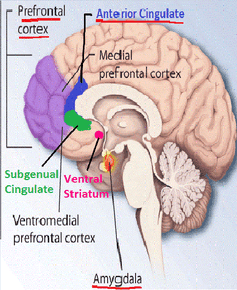
By looking at the timing of activity in the anterior cingulate cortex
(known for a host of functions from pain and conflict to learning), the
anterior insula cortex (associated with arousal and emotion) and the
ventral striatum (associated with rewards and learning), the researchers
created models of how information was passed between these areas. Then a
computer algorithm tried to guess, based on these models, whether an
individual's altruistic decision had been motivated by empathy or by
reciprocity. The high accuracy of these guesses at 77% shows the two
groups of participants had brain activity patterns that differed enough
to classify.
In empathy-driven altruism, the anterior insula (emotion and arousal)
and ventral striatum (rewards) showed a lower than average connectivity,
while reciprocity-driven altruism showed increased connectivity between
these regions. Connectivity in this sense can be imagined as how much
one area is "talking to" another. Although the functions of these areas
are broadly known, the meaning of changes in connectivity is still
difficult to interpret.
By looking at the timing of activity in the anterior cingulate cortex
(known for a host of functions from pain and conflict to learning), the
anterior insula cortex (associated with arousal and emotion) and the
ventral striatum (associated with rewards and learning), the researchers
created models of how information was passed between these areas. Then a
computer algorithm tried to guess, based on these models, whether an
individual's altruistic decision had been motivated by empathy or by
reciprocity. The high accuracy of these guesses at 77% shows the two
groups of participants had brain activity patterns that differed enough
to classify.
In empathy-driven altruism, the anterior insula (emotion and arousal)
and ventral striatum (rewards) showed a lower than average connectivity,
while reciprocity-driven altruism showed increased connectivity between
these regions. Connectivity in this sense can be imagined as how much
one area is "talking to" another. Although the functions of these areas
are broadly known, the meaning of changes in connectivity is still
difficult to interpret.
Can we learn to be more altruistic?
When it comes to implications, the differences between primarily selfish or primarily altruistic participants may be the most important finding. Inducing empathy, by seeing someone shocked, increased giving and associated neural connectivity for selfish individuals - they were more generous to the shocked partners than to the neutral person. The altruistic people, however, shared just as much with the neutral person as the shocked partner. The opposite was true for the reciprocity effect: increased giving to the partner who paid to prevent their shocks was seen in altruistic but not selfish participants.
One could speculate that this implies that altruistic participants are already giving because of empathic motivation, so increasing empathy makes no difference - they are at their "empathy capacity". Similarly, selfish participants may already be acting due to motivations more likely to benefit themselves too, such as reciprocity.
Research on altruism regularly concludes that people have an empathetic motivation but this paper suggests potential for future studies to check whether this is the case for each individual participant. The authors also open doors to more specific measures and targets for further research on reciprocity and empathy.
When it comes to implications, the differences between primarily selfish or primarily altruistic participants may be the most important finding. Inducing empathy, by seeing someone shocked, increased giving and associated neural connectivity for selfish individuals - they were more generous to the shocked partners than to the neutral person. The altruistic people, however, shared just as much with the neutral person as the shocked partner. The opposite was true for the reciprocity effect: increased giving to the partner who paid to prevent their shocks was seen in altruistic but not selfish participants.
One could speculate that this implies that altruistic participants are already giving because of empathic motivation, so increasing empathy makes no difference - they are at their "empathy capacity". Similarly, selfish participants may already be acting due to motivations more likely to benefit themselves too, such as reciprocity.
Research on altruism regularly concludes that people have an empathetic motivation but this paper suggests potential for future studies to check whether this is the case for each individual participant. The authors also open doors to more specific measures and targets for further research on reciprocity and empathy.
The paper shows the importance of analysing subtle differences in brain communication rather than overall activity.
Looking at different brain regions working together, rather than in
isolation, can identify previously elusive psychological concepts, such
as underlying motivations.
Future research is needed on whether these increases in altruism and neural connectivity could last, perhaps with ongoing training. For example, if the techniques used to induce empathy in the study could be employed in some sort of treatment for antisocial behaviour.
However, charities can already make the most of the current findings. They suggest empathy-inducing appeals may be most effective for new supporters, who are not yet "altruistic enough" to donate. Existing supporters, who are already altruistic, may respond more to receiving a token gift they feel they can reciprocate by increasing their donations. The effectiveness of these techniques, already used by many charities, may be explained by the findings. But with limited resources, new insight into cognitive processes that might be harnessed by appeals could help society be a bit more generous.
Future research is needed on whether these increases in altruism and neural connectivity could last, perhaps with ongoing training. For example, if the techniques used to induce empathy in the study could be employed in some sort of treatment for antisocial behaviour.
However, charities can already make the most of the current findings. They suggest empathy-inducing appeals may be most effective for new supporters, who are not yet "altruistic enough" to donate. Existing supporters, who are already altruistic, may respond more to receiving a token gift they feel they can reciprocate by increasing their donations. The effectiveness of these techniques, already used by many charities, may be explained by the findings. But with limited resources, new insight into cognitive processes that might be harnessed by appeals could help society be a bit more generous.
http://www.sott.net/article/313772-Brain-scan-may-reveal-if-you-are-a-true-altruist-or-driven-by-self-interest
3/22/16
Is complaining negatively altering your brain?
Listening to someone complain, even if it's yourself, has never done
anyone any good. Some people say that it may act as a catharsis, a way
to let go of negative emotions and experiences, and maybe letting it all
out once in a while does feel good, but taking a closer look at what
complaining actually does to the brain gives us even more cause to
strive for a positive frame of mind and cut out the complaining.
"Synapses That Fire Together Wire Together"
The brain is a complex physical organ that somehow works in tandem with consciousness to create the personality of a human being, always learning, always re-creating and re-generating itself. It is both the product of reality and the creator of reality, and science is finally beginning to under stand how the brain actually creates reality.
Author, computer scientist and philosopher, Steven Parton, examined the ways in which negative emotions in the form of complaining, both expressed by the self and experienced from others, affect the brain and body, coming up with a number of keen observations that help us to understand why some people can't seem to get out of a negative mood.
His theory suggests that negativity and complaining actually physically alters the structure and function of the mind and body.
"Synapses that fire together wire together," says Parton, which is a concise way of understanding the essence of neuroplasticity, the science of how the brain re-wires itself based on whatever it is repetitively exposed to. Negativity and complaining breeds more of the same, as this theory points out.
Parton explains further:
However, as conscious beings, we have the power to affect this process, simply by being aware of how the universal play of duality is at work in the nascent moments of thoughts. We have the power to choose to generate thoughts from the consciousness of love, over fear, thereby ensuring that the brain and personality are positively altered.
Empathy and the Mob Effect
There is more to this action than just the effect that complaining has on the self. This line of scientific reasoning extends to the dynamics between two-people, giving scientific understanding of how one's complaining brings other people down.
Mirror-neurons ensure that we learn from our environment, and are the essential bio-chemical element of empathy. The brain relates to what another person is expressing, and the empathic portion of ourselves responds by 'trying on' this emotion as an attempt to relate to and understand the externally unfolding drama.
So, when a person enters and drops a huge boatload of gossip, negativity and drama on you, you can be assured that it is affecting you bio-chemically, and is decreasing your chances of actually being happy. Exposure to this kind of emotional outburst actually causes stress, and because stress kills, complaining and negativity may seriously be contributing to your early demise.
Parton refers to this outlook as 'the science of happiness,' and the example of the behavior of complaining does make a fitting case study for the connection between the power of thought and the amount of control a person can exert on the creation of our shared, three-dimensional reality.
The overall view of this is even further condensed, rather precisely, by Parton:
"Synapses That Fire Together Wire Together"
The brain is a complex physical organ that somehow works in tandem with consciousness to create the personality of a human being, always learning, always re-creating and re-generating itself. It is both the product of reality and the creator of reality, and science is finally beginning to under stand how the brain actually creates reality.
Author, computer scientist and philosopher, Steven Parton, examined the ways in which negative emotions in the form of complaining, both expressed by the self and experienced from others, affect the brain and body, coming up with a number of keen observations that help us to understand why some people can't seem to get out of a negative mood.
His theory suggests that negativity and complaining actually physically alters the structure and function of the mind and body.
"Synapses that fire together wire together," says Parton, which is a concise way of understanding the essence of neuroplasticity, the science of how the brain re-wires itself based on whatever it is repetitively exposed to. Negativity and complaining breeds more of the same, as this theory points out.
Parton explains further:
"The principle is simple: Throughout your brain there is a collection of synapses separated by empty space called the synaptic cleft. Whenever you have a thought, one synapse shoots a chemical across the cleft to another synapse, thus building a bridge over which an electric signal can cross, carrying along its charge the relevant information you're thinking about.Furthermore, his understanding of this process includes the idea that the electrical connections most utilized by the brain will become shorter, and therefore more frequently chosen for use by the brain. This is how one's personality is altered.
...Every time this electrical charge is triggered, the synapses grow closer together in order to decrease the distance the electrical charge has to cross.... The brain is rewiring its own circuitry, physically changing itself, to make it easier and more likely that the proper synapses will share the chemical link and thus spark together - in essence, making it easier for the thought to trigger."
However, as conscious beings, we have the power to affect this process, simply by being aware of how the universal play of duality is at work in the nascent moments of thoughts. We have the power to choose to generate thoughts from the consciousness of love, over fear, thereby ensuring that the brain and personality are positively altered.
Empathy and the Mob Effect
There is more to this action than just the effect that complaining has on the self. This line of scientific reasoning extends to the dynamics between two-people, giving scientific understanding of how one's complaining brings other people down.
Mirror-neurons ensure that we learn from our environment, and are the essential bio-chemical element of empathy. The brain relates to what another person is expressing, and the empathic portion of ourselves responds by 'trying on' this emotion as an attempt to relate to and understand the externally unfolding drama.
So, when a person enters and drops a huge boatload of gossip, negativity and drama on you, you can be assured that it is affecting you bio-chemically, and is decreasing your chances of actually being happy. Exposure to this kind of emotional outburst actually causes stress, and because stress kills, complaining and negativity may seriously be contributing to your early demise.
Parton refers to this outlook as 'the science of happiness,' and the example of the behavior of complaining does make a fitting case study for the connection between the power of thought and the amount of control a person can exert on the creation of our shared, three-dimensional reality.
The overall view of this is even further condensed, rather precisely, by Parton:
"...if you're always complaining and belittling your own power in reality, you will not think you have the power to change it. And thus it will never change."http://www.sott.net/article/313876-Is-complaining-negatively-altering-your-brain
3/11/16
The Faith Gene: Are Human Beings Set Up to Believe in a Higher Power?
Are human beings set up to believe in a higher power? Some scientists say yes, based on either a "faith gene" or certain areas of the brain that light up on an MRI when people pray or think about God. But this is a highly destructive "yes," because it reduces spirituality to a mechanical function like heart rate or the secretion of growth hormone. The same evidence fuels the arguments of atheists, who claim that if God is just a chemical reaction, it's time we quit believing in a deity. At the very least, they say, we should stop glorifying God, now that he (or she) has been demoted far below the exalted status one finds in the Bible and the rest of world scriptures.
I think atheists are getting a lot of mileage out of a facile argument. In 1896, long before brain imaging and the discovery of DNA, the famous Harvard philosopher and psychologist William James published a lecture called "The Will to Believe." It contains one idea that is a revelation. James found a way for science to lead to God instead of defeating God. Let me give the revelation a context. James thought people had a right, perhaps even a drive, to say that God existed, and even though they couldn't offer evidence for their religious beliefs, it sustained them with comfort, hope and so on.
Atheists scoff at this rationale, claiming it's childish to fall back on fairy tales about God just because they make you feel better. Far better to grow up and see what's before your eyes: the material world operating through random chance without the slightest sign of a higher intelligence, moral authority, afterlife and all the other trappings of religion. But James was ahead of this argument.
What, he asked, if believing in God actually makes new evidence appear? That was the revelation, because while believing in ghosts or Cinderella won't make either one appear (so far as we know), God is an aspect of our own consciousness. The deity is continuous with the human mind. When Jesus said, "Seek the kingdom of Heaven within," he was pointing to this very continuity. I am paraphrasing James and to some extent going beyond his lecture. But what fascinates me is that he hit upon a familiar notion among seekers today: "You will only see it if you believe it."
by Deepak Chopra
Location:
Orta Doğu
Subscribe to:
Posts (Atom)